June 19th, 2014
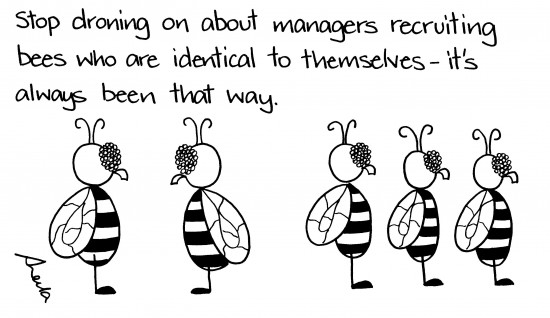 Is it true that “birds of a feather flock together?” Apparently so, and in the 1950s, a couple of scientist gave this tendency a name; homophily. In “Friendship as a Social Process: A Substantive and Methodological Analysis” (1954), Lazarsfeld and Merton looked at both status homophily and value homophily. Status homophily describes individuals with similar social status characteristics that are more likely to associate with each other than by chance. Value homophily refers to the tendency to associate with others who think in similar ways, regardless of differences in status. Lazarsfeld and Merton have not been the only people to pay attention to these tendencies, and in fact, homophily has received a fair amount of attention recently as social technology has allowed us to look at and analyze networks of relationships. The 2001 “Birds of a Feather: Homophily in Social Networks” added to the argument:
“Similarity breeds connection. This principle-the homophily principle-structures network ties of every type, including marriage, friendship, work, advice, support, information transfer, exchange, comembership, and other types of relationship. The result is that people’s personal networks are homogeneous with regard to many sociodemographic, behavioral, and intrapersonal characteristics. Homophily limits people’s social worlds in a way that has powerful implications for the information they receive, the attitudes they form, and the interactions they experience. Homophily in race and ethnicity creates the strongest divides in our personal environments, with age, religion, education, occupation, and gender following in roughly that order. Geographic propinquity, families, organizations, and isomorphic positions in social systems all create contexts in which homophilous relations form.”
To me, the research on homophily is another valuable reminder, that regardless of the wonderful and uplifting things that we say about diversity, human nature still pushes us in a certain direction…toward those that we believe are more like us. No hatred or fear required. One of the great challenges to diversity and inclusion work today is that so many of us believe we are open minded and non-judgmental, that if we simply have the right kinds of intentions and aspirations everything will be fine and we discount the impact of some of our unconscious tendencies. This is how people say wonderful things about the importance of diversity, yet still end up surrounded by people who are very much like them. This is how recruiters and hiring managers who claim to be “color-blind” and solely focused on “talent,” end up hiring people who look and talk and walk the same way.
“Until you make the unconscious conscious, it will direct your life and you will call it fate.” ―C.G. Jung
Inclusion is activist, it is about what you do, not what you say…it does not happen on its own and it does not happen because of our wonderful intentions. Inclusion happens when we make it happen, when we deliberately invite and include additional difference into the spaces and places we occupy. Are you intentionally inviting greater diversity into your personal and professional networks? Does your organization promote and reward it?
Who is in your network and who is not in your network?
Be good to each other.
some related reading:
The Social Origin of Good Ideas – Ronald Burt
The Science of Serendipity in the Workplace – WSJ
How Homophily Affects the Speed of Learning and Best-Response Dynamics – Golub, Jackson
Homophily, Cultural Drift, and the Co-Evolution of Cultural Groups – Damon Centola
Going to SHRM? See you there! You can catch me on June 23rd talking about Building a Culture of Innovation, and June 24th talking about The Future of Diversity and Inclusion. Say hi!
Also, check out my new FORWARD! workshops…already scheduled for Minneapolis and St. Paul, and might be coming your way next!