June 30th, 2014
One of the things that makes efforts toward greater inclusion difficult is that inclusion itself remains a very vague and abstract thing in most organizations. Even leaders that strongly advocate inclusion seem to have a hard time providing clear and concise descriptions of what it is, how it happens, what it feels like, etc. A lot of folks seem to think that inclusion is a pro-diversity state of mind or an attitude, or that it is the absence of hatred and intentional discrimination.
I am not a silver bullet consultant. I do not claim to know what is right for your organization. I have a great deal of experience and insight regarding diversity and inclusion, but I do not know the culture, the context, or the history of your organization. This is why I do not really believe in silver bullets or best practices as they are commonly used…but I am pretty confident that making inclusion more tangible will greatly increase the likelihood that you are going to get some traction in that direction.
In Inclusion and Diversity in Work Groups: A Review and Model for Future Research, Lynn Shore and her collaborators present a model of inclusion that I love and I think can be very useful toward making inclusion a more tangible goal.
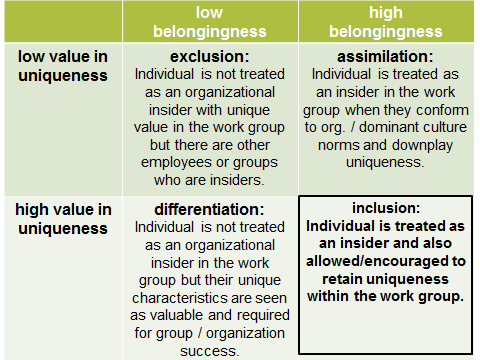
Where would you place yourself? When you think about your experience at work, are you generally excluded, assimilated, differentiated or included? I like this model a lot, I think that this balance of uniqueness and belonging are exactly what we are shooting for. And this is the kind of thing that helps us make inclusion more tangible by providing us with some useful language and definitions. Rather than you and I arguing about whether or not this place is inclusive, we can ask employees which one of these quadrants best captures their experience.
Where would you place yourself, and what does the culture where you work produce the most of?
Be good to each other.