February 8th, 2011
If you have visited this blog before you know that I see diversity and inclusion as incredibly misunderstood. Most organizations have sloppy definitions of diversity and it gets even worse when they talk about inclusion. I am not suggesting that everyone define or view inclusion the same way, but there does need to be some underlying logic and consistency in place if an organization is actually going to be serious about doing inclusion work…if your employees are not able to concisely and consistently explain what inclusion is for your organization, it is not terribly realistic to expect them to be integrating it into their work.
I keep my definition of inclusion pretty simple.
Inclusion is the capacity to include difference.
A few characteristics of inclusion:
- Inclusion is a function of implicit and explicit, intentional and unintentional barriers to access and participation.
- Inclusion is an attribute of an organizations culture.
- Inclusion is not a binary attribute, but rather one existing on a continuum. All social groups include some difference and all social groups exclude some difference. Inclusion is not yes / no, but rather how much…who is included, who is not included and why?
- Inclusion is activist.
- Inclusion is creative.
- Inclusion is dialogic.
I think that these characteristics help us start to have a framework for understanding inclusion and thinking about how to do the work.
Something else that I like to use to help make inclusion a more tangible thing are The Netter Principles. These principles, which go back to 1998 were the answers to the question “what will an inclusive workplace look like?” I do not think that this is the ultimate, perfect, absolute description of what an inclusive organization will look like, but I think it is a pretty good framework to start with and gives leaders some specific things to evaluate and consider in their organization. The above link will take you to a pdf with more detail, but these are the basic principles:
- Demonstrated Commitment to Diversity
- Holistic View of Employees
- Access to Opportunity
- Accommodation of Diversity Physical and Developmental Abilities
- 360 Degree Communication and Information Sharing
- Equitable Systems of Recognition and Reward
- Shared Accountability and Responsibility
- Demonstrated Commitment to Continuous Learning
- Participatory Work Organization and Work Process
- Alignment of Organizational Culture and Process
- Collaborative Conflict Resolution Process
- Demonstrated Commitment to Community Relationships
If you want to have some idea of how inclusive your organization is, give it some quick grades on these 12 things…that should give you a place to start.
Some tools that I like to use in supporting folks that are working to make their organization more inclusive.
Difference Matrix
I am a fan of pretty much everything that comes from the Human Systems Dynamics Institute and Glenda Eoyang, but I think the first thing that I came across and started experimenting with was the Difference Matrix. It is a simple model for considering the pros and the cons of operating in four different quadrant combinations of difference and interaction as well as simple guidance for how to move your team or organization from one quadrant or another.
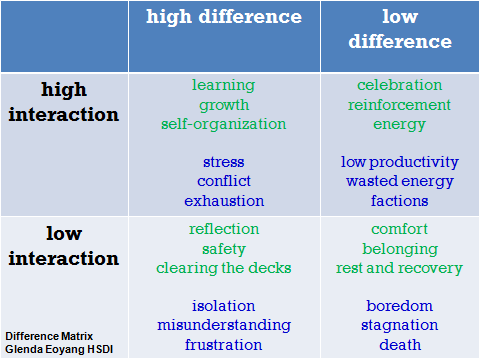
Difference Matrix (HSDI)
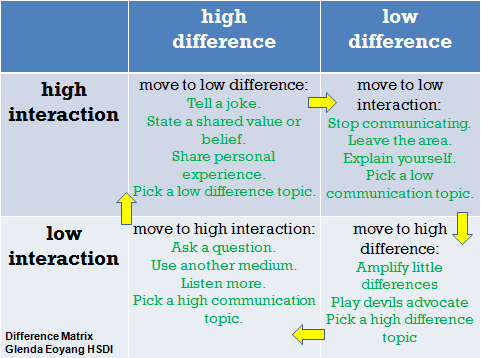
Difference Matrix-Movement (HSDI)
The Generative Relationship STAR
I am also a big fan of the work of Brenda Zimmerman who is one of the authors of a wonderful book called Getting to Maybe: How the World is Changed. She is also helped develop the Generative Relationship STAR, which I think is another flexible and very actionable tool.
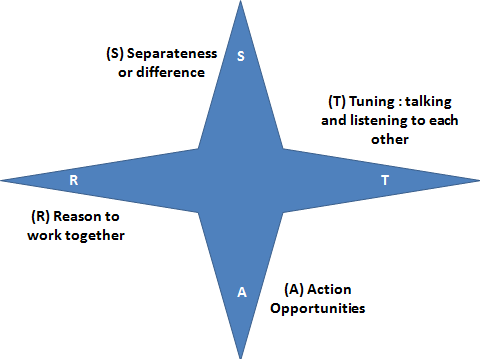
STAR (Zimmerman)
This model points to the four components of a generative team (difference, real communication, an opportunity to walk the walk , reasons to work together). I find it a valuable tool for inclusion work because it has the a deep understanding of the value of diversity built into it. If you have a team that is dysfunctional or if you have a team that gets along well but has never really become a team, this model gives you some places to start.
Generative Engagment
I am also fans of Mary Nations and Royce Holladay (who are also affiliated with HSDI) and I really love their model for Generative Engagement. I still need to spend more time thinking about this model and experimenting with it, but I think it is very applicable to inclusion work…it seems to me that this model shows us the nucleus of inclusive interactions…these are they dynamics underlying inclusion in a 1:1 interaction or across an entire organization.
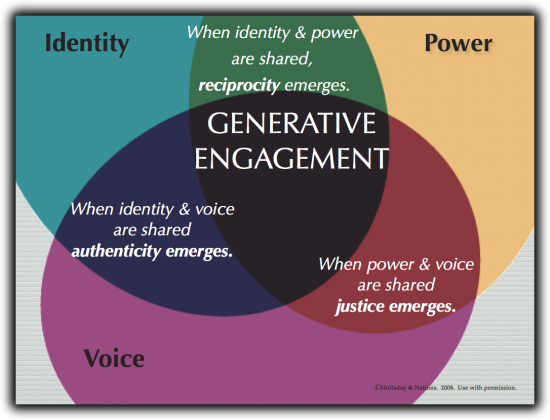
Generative Engagement (Nations / Holladay)
Hope there is some stuff here that is useful, is there something you use and would like to share?
Be good to each other.
[…] This post was mentioned on Twitter by joe gerstandt, joe gerstandt, William Tincup, Marco Campana, Jennifer Sertl and others. Jennifer Sertl said: Remember the wisdom of outliers! Must read: Breaking down "inclusion" http://bit.ly/hxQCyW via @joegerstandt #diversity #resilience #a3r […]
[…] I keep my definition of inclusion pretty simple. Joe Gerstandt | Keynote Speaker & Workshop Facilitator | Illuminating the value of difference […]
[…] is a system’s capacity to include difference (definition from Joe Gerstandt). One of the values of including difference is that it actually fuels innovation (see Frans […]
[…] is a system’s capacity to include difference (definition from Joe Gerstandt). One of the values of including difference is that it actually fuels innovation (see Frans […]